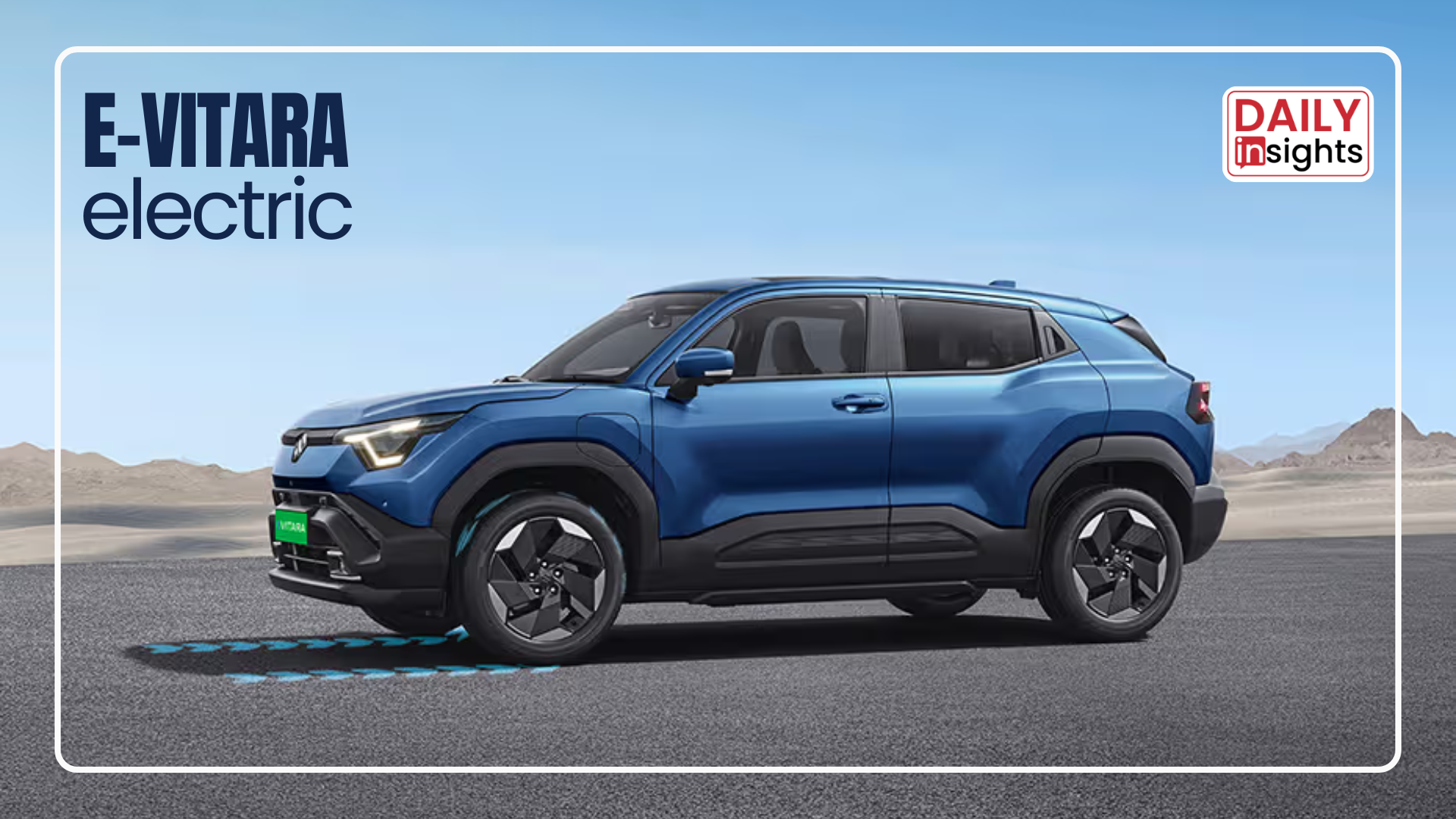
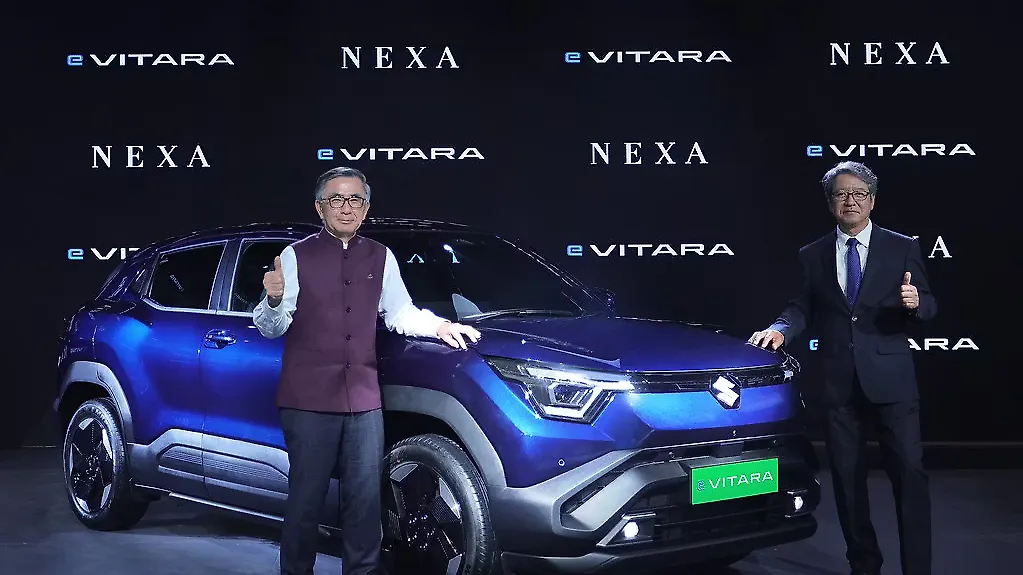
The e-Vitara marks a significant milestone for Maruti Suzuki: its first fully plug-in electric vehicle (EV) SUV. Unlike many EVs, which are niche or limited, Maruti intends the e-Vitara to be a global model produced in India and exported to over 100 countries.
The company is leveraging its strengths in scale, cost efficiency, and dealership network to make the e-Vitara both competitive in pricing and broad in reach. However, challenges remain – notably sourcing key raw materials like rare-earth magnets. Already, Maruti has trimmed initial production targets due to supply chain constraints.
Let’s break down how the e-Vitara stacks up in terms of pricing, range, technicals, and features.
Price & Variants
- The estimated ex-showroom price in India ranges from ₹17 lakh for the base version (49 kWh) up to ₹22.5 lakh (for the higher 61 kWh variant)
- Some sources list a more conservative bracket of ₹17 to ₹22.50 lakh as the expected pricing spread.
- In certain reports, a mid-variant with the 61 kWh battery is suggested at ₹20 lakh.
- These are estimates and could vary based on location (state taxes, incentives) and variant features.
Because of incentives, subsidies (central and state EV schemes), and local taxes, the on-road price could differ significantly across states. (The ex-showroom price gives a baseline before registration, insurance, and incentives.)
Battery, Range & Efficiency (Mileage)
Mileage in the EV context is better thought of as driving range per full charge, or efficiency in km per kWh or equivalent.
Battery Options & Chemistry
- e-Vitara will use LFP (Lithium Iron Phosphate) battery chemistry, which offers good cycle life and thermal stability.
- Two battery pack sizes are confirmed: 49 kWh and 61 kWh.
- In global markets, Suzuki lists WLTP range up to 346 km (49 kWh) and 426 km (61 kWh).
Claimed Range in India
- In India, the ARAI-certified range (or claimed figure) is up to 500 km for the 61 kWh variant.
- The 49 kWh variant is expected to deliver ~400 km in Indian driving conditions.
Note: Real-world range will typically be lower than claimed – depending on driving style, traffic, temperature, use of climate control, terrain, etc.
Efficiency & Charging
- For the 61 kWh battery, fast charging support is claimed – peak 150 kW DC – allowing 10% → 80% charging in 45 minutes.
- AC charging (for home/destination) is expected to support 7 kW or 11 kW modes, enabling full charge overnight (8-11 hours depending on battery size). In the UK drive test, the 49 kWh model’s WLTP range is 214 miles ( 345 km); the 61 kWh model gives 243 miles (~391 km) under WLTP norms.
Power, Performance & Drivetrain
- The 49 kWh variant is expected to produce ~ 142 bhp and 192.5 Nm of torque.
- The 61 kWh version is likely to be tuned higher; reports indicate options up to ~172 bhp (in some contexts).
- Initially, the Indian launch is expected only in front-wheel-drive (FWD) single-motor configuration.
- In the export/global version, Suzuki has hinted at ALLGRIP-e (electric AWD) for select markets (on a larger battery).
- In performance terms, a UK test on an AWD prototype claimed 0–100 km/h in 7.4 seconds; the FWD version was slower (circa 9.5 s) for 0–62 mph ( 0-100 km/h).
Thus, for Indian buyers initially, expect FWD only, with performance sufficient for everyday usage.
Dimensions, Package & Practical Features
- The e-Vitara retains an SUV stance with body cladding, flush door handles, blacked-out elements, and Y-shaped LED DRLs.
- The charging port is likely placed on the front-left fender.
- Alloy wheels (18- or 19-inch options) with aero covers enhance efficiency.
Interior & Comfort
- Twin displays: a 10.25-inch touchscreen infotainment and a 10.1-inch digital instrument cluster.
- Front seats are ventilated; the driver’s seat offers 10-way power adjustment.
- Rear seats can slide and recline, with a 40/20/40 split layout.
- A panoramic sunroof (fixed glass) is included in select variants.
- Ample storage, connected features via Suzuki Connect, and smartwatch integration for vehicle info & charging status.
Safety & ADAS
- Level-2 ADAS suite with over 15 functions: adaptive cruise control, lane departure warning, high beam assist, forward collision braking, blind-spot monitoring, etc.
- Multiple airbags (six + driver knee airbag), ESP/ESC, ABS with EBD, 360° camera, ISOFIX child seats.
- Suzuki claims strong safety credentials and uses advanced sensors.
Chassis, Suspension & Driving Dynamics
- The platform is based on HEARTECT-e, a dedicated EV platform developed by Suzuki (in partnership with Toyota/Daihatsu).
- Ground clearance is moderate – not extreme off-road, but decent for rough Indian roads.
- Regenerative braking and multiple regen modes aid efficiency and range.
Strengths & Challenges
- Range + battery options: 400-500 km claimed, enough for most Indian usage.
- Affordable pricing (for its segment) relative to many premium EVs.
- Rich feature set including Level-2 ADAS, ventilated seats, panoramic roof, etc.
- Maruti’s aftersales & service network – an advantage for servicing, parts, and trust.
- Export potential & scale – manufactured in India for both domestic and overseas markets.
Challenges & Risks
- Real-world range gap: Claim vs actual will differ.
- Charging infrastructure: While Maruti may establish charging stations within its network, widespread public EV charging infrastructure is still evolving in India.
- Supply chain constraints: Rare earth magnets and critical components pose risks; Maruti has already cut short-term production targets.
- Competition: Other EV players (Tata, MG, Hyundai) are also pushing feature-rich models.
- Variant/AWD offering delay: AWD or ALLGRIP-e may be limited or delayed in India.
How It Compares to Rivals (Brief)
- Tata Curvv EV: Offers a range of 502-585 km (for 45/55 kWh battery) and is priced similarly.
- Hyundai/MG EVs: Premium interiors, brand appeal, but often at a higher cost.
- e-Vitara’s advantage lies in its balance of range, feature set, and Maruti’s service reach.
Launch Timeline & Outlook
- Production of e-Vitara began at the Gujarat (Hansalpur) plant in August 2025, with the first unit flagged off by the Prime Minister.
- Export is integral – Maruti plans to ship units to over 100 countries.
- Some reports estimate deliveries or official availability in India around late 2025 (or early 2026), depending on demand, supply constraints, and regulatory clearances.
Conclusion
The Maruti Suzuki e-Vitara is a bold step for Maruti into the EV domain. With competitive pricing (₹17-22.5 lakh), a decent range (400–500 km claimed), and a strong feature package (ADAS, connectivity, safety), it aims to bridge the gap between premium EVs and mainstream adoption. However, real-world performance, charging infrastructure, and supply chains will be critical to its success.
Note: The information shared is based on data available as of 2025. For the latest and most accurate details, please visit the official website or trusted online sources.

Maruti Suzuki’s push to produce the e-Vitara for over 100 countries is definitely exciting. It’ll be interesting to see how they handle the supply chain constraints, especially when it comes to sourcing materials like rare-earth magnets.
It’s great to see Maruti Suzuki moving into the EV space with the e-Vitara. The fact that they’re planning to export it globally speaks volumes about the quality and potential of the vehicle. But I wonder how supply chain constraints will affect availability and price in the long term.
The fact that Maruti is positioning the e-Vitara for global markets is a smart move, especially with its wide reach and established dealership network. It’ll be interesting to see how quickly they can ramp up production given the challenges with raw material sourcing.
The potential supply chain issues mentioned in the article are concerning. Do you think these will affect the overall rollout of the e-Vitara, or will Maruti be able to overcome these hurdles as they scale up production?